
The Content Rating Problem Nobody in LitRPG Is Talking About
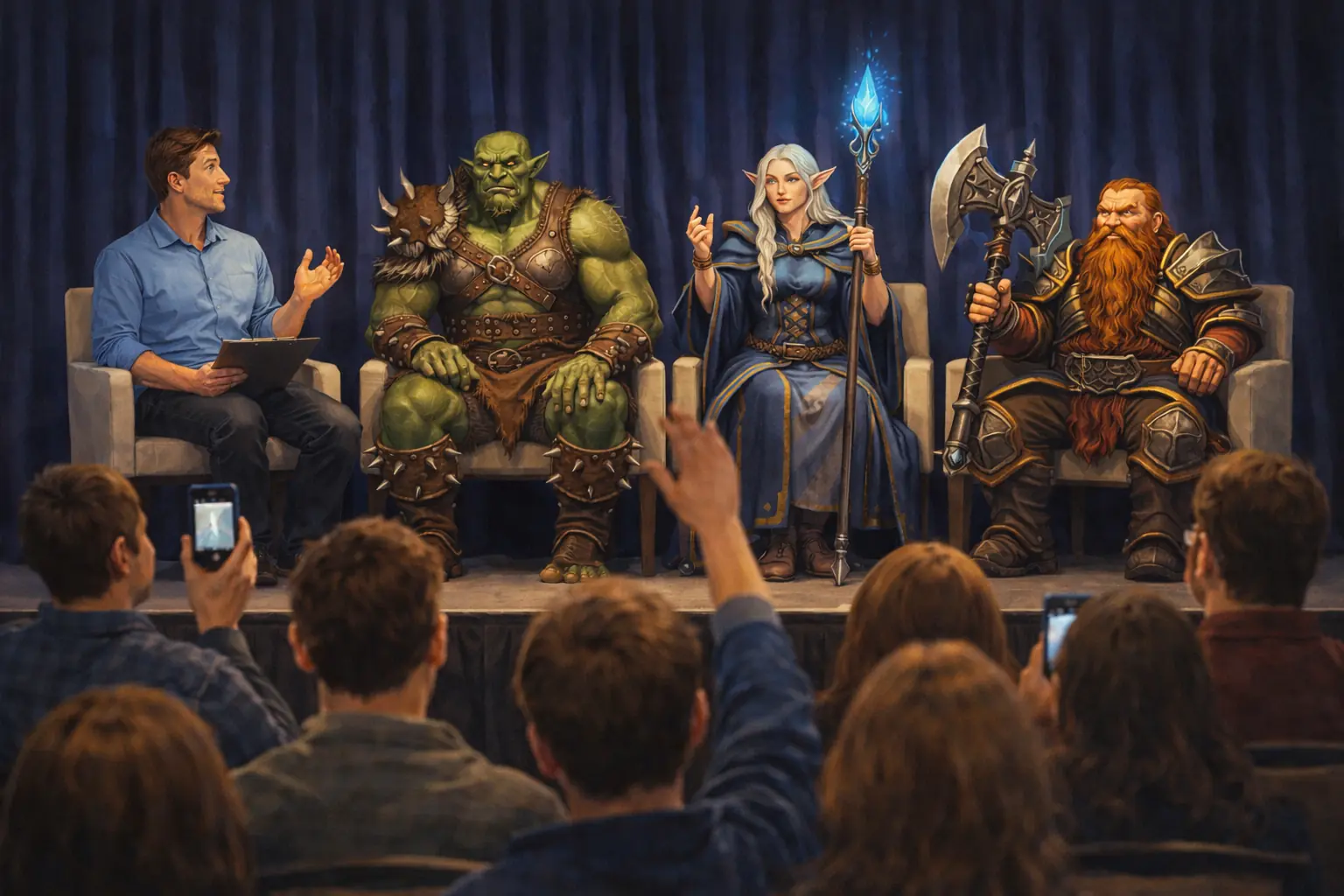
LitRPGCon 2025, Denver. The humor panel.
An intimate 100 people packed the room — standing room only. Five of the genre's biggest comedy writers on stage: Matt Dinniman, Dakota Krout, Hunter Mythos, James Hunter, Brian Nordon.
Someone from the audience asked the question everyone in the room was thinking: Where do you draw the line?
Dakota Krout talked about keeping things family-friendly — "Good. Clean. Fun." is the brand and the line. Hunter Mythos discussed leaning into edgier territory. Then someone turned to Dinniman.
He paused. Looked out at the audience. Said "Wow."
The room erupted. Because this is the man whose books feature body horror, a recurring alien AI foot fetish, and a profanity-laced catchphrase that a child once shouted at a book signing while his parent waited in line. The distance between the question and his body of work was the joke.
But what happened next was more interesting than the laugh. Dinniman got serious. A fan asked about religion in his writing, and he talked about studying theology — how that academic background shapes the way he handles faith and mythology in his stories. When asked about content and audience, he acknowledged directly that kids read his books. Then he told the book signing story himself: a child walked up and said "glurp glurp motherf*****" while their parent stood right there.
He mentioned he'd worked for child protective services.
The biggest comedy writer in LitRPG isn't ignoring the content question. He's thinking about it more carefully than most people in the genre assume. And when we started digging into the data — demographics, platform policies, payment processor rules, monetization patterns — we found he's not the only one who should be.
This isn't a piece about what anyone should or shouldn't write. It's about what the data shows when you look at the gap between who authors write for, who actually reads, and what that means for platform discoverability and revenue.
Who's Actually Reading Your Story?
Here's the demographic reality that most LitRPG authors haven't fully reckoned with.
Royal Road's largest age group is 18-24, according to Similarweb. But community self-reporting puts the core readership younger — 13 to 25, per Royal Road forum discussions. Similarweb can't precisely track users under 18, which means the actual minor population on the platform is likely undercounted.
This lines up with a structural fact about the genre: LitRPG reads like a video game. Leveling up, stat sheets, dungeon crawling, skill trees, progression mechanics. And according to Pew Research's 2024 survey, 85% of U.S. teens play video games. Among boys, that number is 97%.
When virtually every American teenage boy plays video games and an entire literary genre is designed to read like one, the pipeline is structurally inevitable.
It's not theoretical. Dinniman himself has acknowledged it publicly.
"So many of them are in younger demographics, or people who work in jobs that allow them to consume audio books and become big fans of them."
— Matt Dinniman, Anime Herald (December 2025)
"It was originally mostly males, mostly males in their 20s that were listening to LitRPG."
— Matt Dinniman, Audible interview
Dinniman also noted in the same interview that the audience is diversifying: "We're getting more and more female listeners, which is fantastic... We have more representation from all sorts of walks of life."
The broader data supports this. A SAGE Open study found that 87.3% of science fiction and fantasy readers started reading the genre before age 15. The National Literacy Trust's 2025 report found that only 1 in 3 children aged 8-18 enjoy reading for fun — a 36% decline since 2005 — with the steepest drop among boys aged 11-16. That's exactly the demographic most likely to discover LitRPG through gaming.
Then there's the expansion problem. The DCC Webtoon, which Dinniman describes as "reaching a completely different audience — massive, way beyond books and audio combined," exists on a platform where under-18 is the fastest-growing segment, with over 30% compound annual growth rate according to Grand View Research. In South Korea, 1 in 5 webtoon and web novel app users are aged 10-19.
And in February 2026, Playmates Toys debuted DCC collectibles at Toy Fair — a toy line based on a series where characters encounter graphic violence, sex jokes, and body horror. The series is simultaneously being adapted into a print graphic novel by Vault Comics and Simon & Schuster.
The parents-asking-about-appropriateness conversation is instructive. When someone on TexAgs asked if DCC was appropriate for a 12-year-old, the responses compared it to Deadpool and Grand Theft Auto — content that is age-restricted but widely consumed by minors. The community consensus lands around 14+.
| Source | Recommended Age | Notes |
|---|---|---|
| Common Sense Media | 16+ | "Violence, swearing in sci-fi role-play adventure" |
| Mom Read It | 14+ | Titled "Trust Me, It's a YA Crossover" |
| Goodreads community | 14+ | "Graphic violence, adult themes" |
| Huntley Area Public Library | High school+ | "Published for adults, but older teens may enjoy" |
| TexAgs forum | Debated for 12-year-old | "If your kid plays M-rated games, this is no worse" |
None of this means authors are doing anything wrong. It means the actual audience for LitRPG skews younger than the content ratings suggest — and that gap has real implications for platform strategy and revenue.
How Content Ratings Actually Work on Royal Road
Here's something that surprises many authors: Royal Road doesn't have tiered age ratings. No Everyone / Teen / Mature / Adult scale. Instead, it uses a binary tag system with four content warning categories.
| Tag | Definition | Notes |
|---|---|---|
| Profanity | Moderate/high frequency swearing or offensive language | Cannot appear in titles or descriptions |
| Sexual Content | Explicit sexual scenes or descriptive sexual content | Fade-to-black does NOT require the tag |
| Graphic Violence | Detailed physical harm, bloodshed, mutilation | Formerly "Gore" — renamed October 2023 |
| Sensitive Content | Torture, slavery, substance abuse, mental illness, self-harm | Formerly "Traumatising/Disturbing Content" — renamed October 2023 |
Authors self-report these tags during story submission. Staff reviews them within 12-24 hours. Readers can report mis-tagged stories post-publication.
The Overtagging Problem
Before the October 2023 revision, the system was nearly useless.
44% of all fictions were tagged as Gore. Over 25% were tagged as Traumatising Content. Royal Road staff acknowledged these numbers were "characteristically untrue." What happened was predictable: defensive overtagging. Authors applied every possible tag to avoid moderation action, which made the tags meaningless for readers trying to filter content.
As one forum user put it: "Does this tag even have any meaning anymore?"
The 2023 revisions loosened definitions and renamed the tags. But the revisions were driven primarily by Apple App Store and Google Play Store compliance requirements, not a shift in internal content policy. As moderator Milles Sand noted, "admins have stated repeatedly that the actual enforcement isn't changing." The stricter-sounding language was for app stores.
The Binary Problem
This is the system's biggest design flaw: there are no severity levels. A story with a single violent scene gets the same Graphic Violence tag as a story with constant graphic violence. A single implied sexual encounter triggers the same Sexual Content tag as frequent explicit scenes.
This forces uncomfortable all-or-nothing decisions. The most common questions on Royal Road's forums are what you'd expect:
- Does fade-to-black require the Sexual Content tag? (No.)
- Does blood without dismemberment count as Graphic Violence? (Generally no.)
- My story has one graphic scene — do I tag the whole thing? (Yes.)
- Does the Sensitive Content tag spoil my plot twist? (Possibly. No solution offered.)
The result: when in doubt, authors tag. Which perpetuates the overtagging cycle that made the system unreliable in the first place.
The Sexual Content Penalty
Here's where it gets concrete. Three of the four tags — Profanity, Graphic Violence, Sensitive Content — carry zero discoverability penalty. They don't affect Trending, Rising Stars, Popular This Week, Best Rated, or search results. They appear normally on both the website and the mobile app.
Sexual Content is different.
Stories with this tag are hidden by default on Royal Road's mobile app. Readers must go through a two-step opt-in (Settings → Show More Content → Show Mature Content) and set their age in their profile. This is the only content tag with this penalty.
The result: sexually tagged stories are essentially absent from all four major discovery lists. We checked the top 20 of each.
| Discovery List | Stories with Content Warnings (Top 20) | Percentage |
|---|---|---|
| Best Rated | ~3 stories | ~15% |
| Trending | ~0 stories | ~0% |
| Rising Stars | ~2 stories | ~10% |
| Popular This Week | ~2 stories | ~10% |
Best Rated is dominated by clean or Profanity-only stories: Mother of Learning, The Perfect Run, Super Minion, Beware of Chicken.
Royal Road didn't design this penalty for editorial reasons. It's app store compliance — Apple and Google require age-gating for sexual content. But the effect on discoverability is the same regardless of why it exists.
There's also a compounding effect: reduced mobile discoverability means fewer readers, which means fewer ratings, which means worse engagement metrics, which means lower ranking. The penalty feeds itself.
And there's a separate data point worth noting. Royal Road forum consensus is clear: smut chapters get 33-50% fewer views than regular chapters in the same story. As one community discussion put it, "Smut is a ScribbleHub thing." The RR audience, as a whole, expects plot-driven content.
How Other Platforms Handle It
There is no industry standard for web fiction content ratings. Every platform does it differently, and none of them have solved the fundamental problem.
| Platform | Rating System | Erotica? | Explicit Sex? | Mature Search Suppression? |
|---|---|---|---|---|
| Royal Road | 4 binary warning tags | Banned | Allowed (minor part) | Mobile app only (Sexual Content tag) |
| Wattpad | Everyone / Mature | Banned | Allowed with Mature | Heavy (hidden from search engines + under-17 users) |
| Scribblehub | Everyone / Mature / Adult | Partially | Allowed with Adult tag | Minimal |
| Amazon KDP | Standard / Adult | Yes (erotica category) | Yes (may be suppressed) | Yes — "the dungeon" |
| AO3 | 5 ratings + 4 warnings | Yes | Yes | None |
A few details stand out.
Wattpad ran an AI-moderation purge in 2024 that mass-flagged stories and shadow-banned creators. It raised its age-of-consent threshold to 18+ and now excludes Mature-rated stories from external search engines entirely.
Amazon KDP has what authors call "the dungeon" — books classified as Adult disappear from search, recommendations, and also-bought lists. No Amazon Ads allowed. Authors receive no notification when it happens. Even keywords like "daddy" or "omegaverse" can trigger it. Enforcement is inconsistent and unpredictable.
AO3 is the outlier. Five rating tiers, four mandatory archive warnings, plus "Creator Chose Not To Use Warnings." No search suppression at any level. AO3 was founded in 2008 specifically in response to platform purges on LiveJournal and FanFiction.net, and won a Hugo Award in 2019. Its philosophy: maximum reader responsibility, minimum platform intervention.
Scribblehub is more permissive than Royal Road — sexual content is allowed as a major story component, and authors writing mature content are commonly advised to cross-post there.
Traditional media — film (MPAA), television (TV Parental Guidelines), video games (ESRB) — all use professional raters or industry boards. Web fiction relies entirely on author self-reporting. A 2024 University of Bristol study found that self-annotation by authors produces "incorrect labels limiting classification results." Binary adult/non-adult classification achieved only ~70% accuracy even with transformer models. Multi-class classification performed poorly.
The rating systems authors rely on are structurally limited, inconsistently applied, and no two platforms agree on how to run them.
What Content Ratings Mean for Your Money
This is where the data gets uncomfortable.
The Payment Processor Chain
Between your reader's credit card and your bank account sits a chain: Visa/Mastercard → Stripe/PayPal → Platform (Patreon, Gumroad, Chapter Chronicles) → You. Every link in that chain has content policies. And any link can break.
Stripe's prohibited businesses list explicitly includes:
"pornography and other mature audience content (including literature, imagery, and other media) designed for the purpose of sexual gratification"
Written fiction is not exempt — "literature" is specifically called out. At scale, acquiring banks take notice. Accounts have been flagged after reaching approximately $50K in revenue. Termination puts a business on the MATCH list for five years, effectively blacklisting it from payment processing.
This isn't theoretical. In March 2024, Gumroad banned most NSFW content with roughly 24 hours' notice, citing payment processor restrictions. Creators lost revenue streams with zero warning. Patreon has suspended adult creators under payment partner pressure — Vice reported mass shutdowns. The pattern is consistent: platforms tolerate adult content until payment processors force action, then enforce broadly and suddenly.
Violence, profanity, and dark themes face far less scrutiny from payment processors than sexual content. This asymmetry is the single most important fact for author monetization strategy, and it's one most authors learn too late.
The Top Earners Are Moderate-to-Clean
| Author | Series | Monthly Patreon | Content Level |
|---|---|---|---|
| Casualfarmer | Beware of Chicken | 6,003 members | Clean / Cozy |
| pirateaba | The Wandering Inn | ~$20K (est.) | Mature themes, no NSFW |
| Matt Dinniman | Dungeon Crawler Carl | 17,752 members | Mature: violence, profanity, no explicit sex |
| Shirtaloon | HWFWM | $15-20K | Moderate: violence, some profanity |
Every one of the top-earning Royal Road authors writes in the moderate-to-clean range. None produce sexually explicit content. This isn't coincidence — it's the compounding effect of audience size, platform discoverability, and payment processor tolerance working together.
The Three-Tier Framework
Based on the data, content choices for Royal Road authors map to three strategic tiers with distinct trade-offs.
| Clean / Cozy | Mature (no explicit sex) | Explicit Sexual Content | |
|---|---|---|---|
| RR Discoverability | Full (all lists, mobile + web) | Full (no penalty for violence/profanity) | Suppressed on mobile app |
| Audience Size | Broadest | Broad (some self-selection) | Narrowest |
| Patreon Conversion | Standard (2-17%) | Strong (loyal, engaged audience) | Highest per-reader, smallest pool |
| Payment Processor Risk | None | None | High (Stripe prohibition) |
| Traditional Publishing | Full access | Full access (DCC model) | Limited |
| Adaptation Potential | High | High (Universal International Studios is adapting DCC) | Low |
| Merchandise | Straightforward | Viable (DCC sells Princess Donut stickers, not gore imagery) | Challenging |
The paradox: mature content may convert individual readers at higher rates, but explicit sexual content shrinks total discoverable audience, introduces processor risk, and limits downstream revenue. High per-reader loyalty set against platform suppression, Stripe's explicit prohibition, and audience limitation.
The DCC Model
Dungeon Crawler Carl occupies what the data suggests is the commercial sweet spot: mature but not explicit. Dark humor, graphic violence, profanity — but no explicit sexual content. This positioning has enabled:
- 6+ million copies sold
- #2 on the New York Times Audio Fiction bestseller list (March 2025)
- Universal International Studios adaptation, produced by Seth MacFarlane's Fuzzy Door (Chris Yost writing)
- Ace Books (Penguin Random House) print deal
- Playmates Toys collectibles debuted at Toy Fair 2026
- DCC Webtoon adapted into a print graphic novel (Vault Comics / Simon & Schuster)
Violence, dark humor, and profanity were not barriers to a single one of these deals. Explicit sexual content likely would have been.
What the Best Authors Get Right
We're not prescribing content choices. Every author's creative decision is their own. But when you look at the most commercially successful authors in the genre, clear patterns emerge.
It's a Spectrum, Not a Binary
Dakota Krout's "Good. Clean. Fun." and Matt Dinniman's dark comedy both thrive. Casualfarmer's cozy cultivation and Shirtaloon's moderate-content action-adventure coexist on the same platform. RavensDagger's Cinnamon Bun: A Wholesome LitRPG has over 15 million Royal Road views. A Fantasy Book Review critic wrote that Andrew Rowe's Sufficiently Advanced Magic "perfectly fits in that illustrious middle ground of appealing to both YA and adult fantasy readers."
What the successful authors share isn't a content level. It's intentionality.
Character-Driven, Not Shock-Driven
Dinniman's humor doesn't come from mechanically alternating dark and light scenes. It emerges from characters coping with an impossible situation.
"I don't go out of my way to say 'Okay, that scene was pretty dark. Let's make a funny scene now.' Instead, I try to rely on the characters themselves to get from point A to B, and humor is oftentimes a major coping mechanism."
— Grimdark Magazine (September 2024)
This tracks with research in Cognitive Processing that found dark humor appreciation correlates with low mood disturbance and low aggression — the opposite of what critics tend to assume. Gallows humor, as NIH research on veterans confirms, functions as a coping mechanism for "physically and psychologically challenging situations." That maps exactly to what Carl and Donut are doing in the dungeon.
Slate's review (February 2026) captured the dynamic precisely:
"The series' humor ranges from the absurd to the sophomoric, but the underlying tone throughout is a dark resignation, that working-class mordancy adopted by the world's underlings as they struggle to maintain their dignity while being exploited by indifferent elites."
Aggressive Self-Editing
Dinniman writes approximately 800,000 words for each ~270,000-word published book. That's roughly a 3:1 ratio. The content that makes it into Dungeon Crawler Carl was written, evaluated, and in most cases, deliberately rejected.
This is the opposite of reckless. It's the most disciplined editing process of any major author in the genre.
The Merch Tells the Story
DCC merchandise is Princess Donut stickers, "Glurp Glurp" t-shirts, humor catchphrases. Not gore imagery. Not body horror. Even the darkest series in LitRPG presents its family-friendly face in public-facing products.
The Wandering Inn sells plushies. Beware of Chicken is cozy by design. The highest-grossing brands in the genre lean into the whimsical, character-driven side of their stories for merchandise, regardless of how mature the source material is.
Content Warnings as Trust Signals
The best authors don't fight the warning system — they use it. Author notes that provide context before a sensitive chapter. Specific descriptions of what readers will encounter. Respect for reader autonomy.
Forum data consistently shows that transparent content warnings increase reader trust and reduce negative reviews. Readers who know what they're getting into are more forgiving of mature content than readers who are caught off guard.
The Market's Answer: Parallel Tracks
The market isn't asking adult authors to soften their content. It's creating parallel products for different audiences.
- Kids LitRPG: Audible maintains a dedicated category. Dan Sugralinov's "The Crafter" series (2023). Patrick Carman has run over 3,000 school visits using LitRPG-style mechanics to hook reluctant readers.
- Family-Friendly LitRPG: The LitRPG Podcast maintains a dedicated "Family Friendly" tag in its database.
- Cozy LitRPG: The fastest-growing subgenre in the category as of 2025.
- YA LitRPG: 303+ listings in upcoming releases alone.
This is a healthy response. Creative freedom is preserved while audience diversity is acknowledged. No one is being asked to change what they write.
And the emergence of these tracks matters beyond the genre. Only 1 in 3 children aged 8-18 enjoy reading for fun — a 36% decline since 2005, according to the National Literacy Trust. The steepest drop is among boys aged 11-16. LitRPG — through the gaming pipeline — is reaching young readers who otherwise might not pick up a book at all.
When Patrick Carman uses LitRPG mechanics to get reluctant readers in schools turning pages, that's genuinely valuable. When a teenager discovers Dungeon Crawler Carl through a Webtoon and picks up the audiobook, that's valuable too — even when the content is mature. The genre's ability to pull non-readers into reading is one of the most important things happening in publishing right now, and the emergence of age-appropriate tracks ensures there's a version for everyone.
What This Means for Your Story
We're not offering prescriptions and this isn't legal advice. But the data points in clear directions.
Know your actual audience, not your intended audience. The demographic data says LitRPG readers skew younger than most authors assume. If your story reads like a video game, teenagers are finding it — regardless of who you had in mind when you started writing.
Content warnings are a trust signal, not censorship. Good warnings increase reader trust and reduce negative reviews. The best authors in the genre use them proactively, not defensively.
The "mature but not explicit" zone is where the top earners sit. This isn't a value judgment — it's what the platform data, payment processor policies, and top earner patterns consistently show. Maximum reach, maximum monetization, maximum adaptation potential.
Payment processors care about sexual content far more than violence. Stripe prohibits adult literature explicitly. Gumroad can pull the rug overnight. Patreon has suspended creators under processor pressure. This is a business reality that exists independent of anyone's opinion about what fiction should contain.
The best authors are intentional. Whether they write clean or dark, they've thought about the content question carefully. Dakota Krout's "Good. Clean. Fun." is as deliberate as Dinniman's 800,000-word-to-270,000-word editing process.
Matt Dinniman didn't dodge the content question at LitRPGCon 2025. He engaged with it thoughtfully — as someone who studied theology, worked in child protective services, is a father of three daughters, and writes books where a cat in a tiara helps a man survive an alien death game. He knows who's reading. He's thought about what that means. His 6 million copies suggest the thinking paid off.
If you're writing serial fiction, the content question deserves your attention too.
Frequently Asked Questions
How do content ratings work on Royal Road?
Does the Sexual Content tag affect discoverability on Royal Road?
What content level do the top-earning Royal Road authors write at?
Do payment processors restrict mature fiction content?
Related Articles
Does Publishing Daily Actually Get More Followers? Data from 500+ Royal Road Serials.
Everyone says publish daily or get left behind. We collected data on 550+ Royal Road stories across every status and analyzed their publishing schedules. The surprising finding: frequency barely correlates with success — and when you control for story age, the effect disappears entirely.
How Sky Pride Hit #1 on Royal Road Without Reinventing a Single Trope
Sky Pride is the highest-rated ongoing story on Royal Road. It uses every xianxia trope in the book—sects, pill refining, flying swords, ghost grandpa in a ring. We analyzed reviews, Reddit threads, and author strategy to understand why execution beats innovation.
I Analyzed 244 Cyber Dreams Reviews. What Hooks Readers Isn't What You Think.
We analyzed 244 positive reviews from Plum Parrot's hit cyberpunk LitRPG series. The most praised element wasn't the setting or progression system—it was something authors rarely prioritize.
Ready to Start Publishing Your Story?
Join authors building their creative business on Chapter Chronicles. Free to start, simple pricing when you earn.
Sign Up Free