
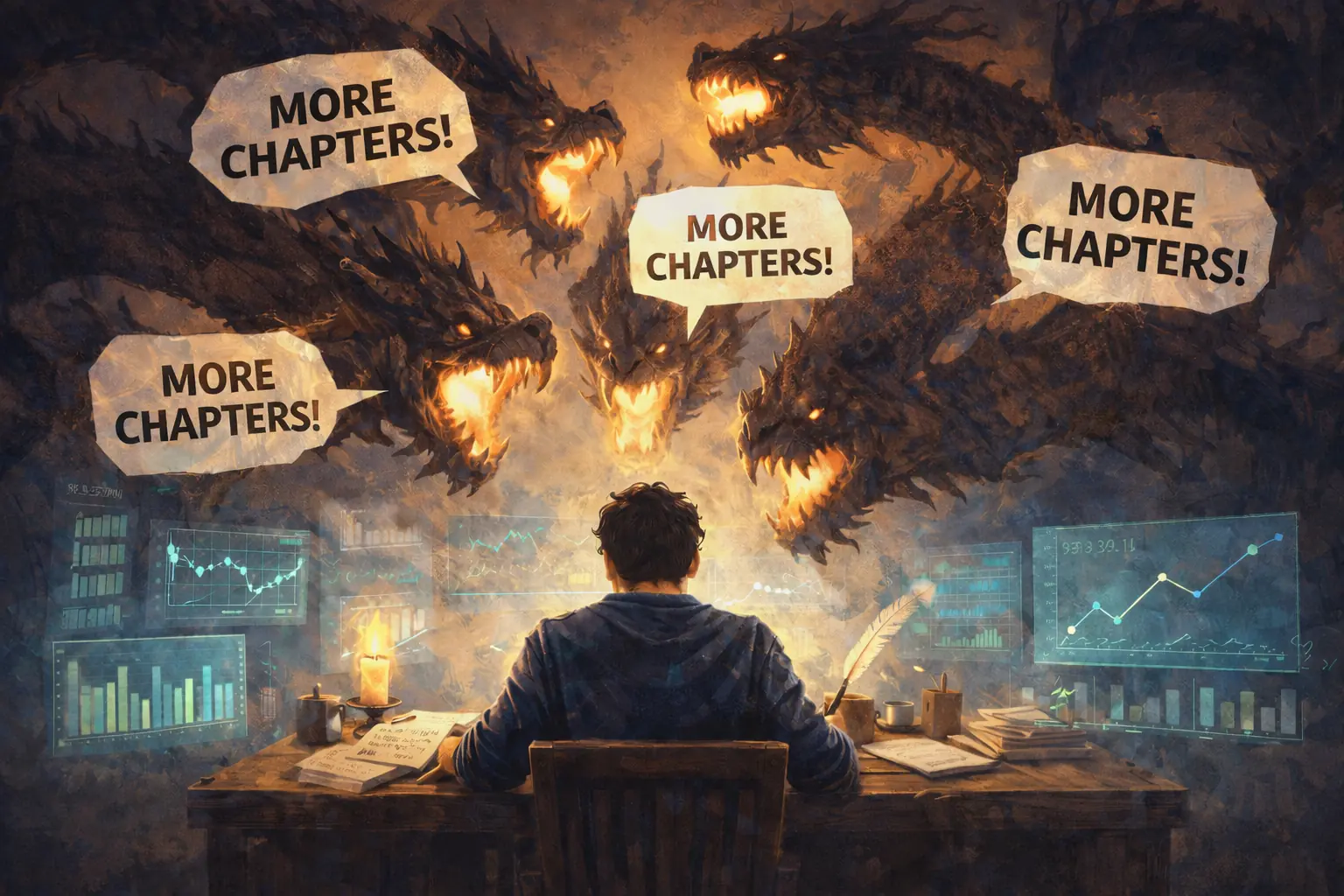
Does Publishing Daily Actually Get More Followers? Data from 500+ Royal Road Serials.
"If you're not publishing daily, you're falling behind."
If you've spent any time in web fiction communities, you've heard some version of this. Daily releases feed the algorithm. Readers expect constant content. Take a day off and your ranking drops. The successful authors publish every single day.
We analyzed 524 Royal Road stories with 20+ chapters — sampled across ongoing, completed, hiatus, and dropped statuses to avoid survivorship bias. We extracted nearly 97,000 chapter timestamps, computed publishing cadences, and compared them against follower counts, ratings, and Patreon adoption.
The short version: Publishing frequency has surprisingly little correlation with success. And when you control for story age, the effect disappears entirely. The "publish daily or die" advice? The data doesn't support it.
The Data at a Glance
| Metric | Value |
|---|---|
| Stories Analyzed | 524 (20+ chapters) |
| Total Chapter Timestamps | 96,809 |
| Release Gap vs Followers (Pearson r) | +0.29 (weak positive) |
| Release Gap vs Followers/Month (age-adjusted) | -0.03 (negligible) |
| Most Common Cadence | Every 2-3 days (41% of stories) |
Note: All schedule metrics use median inter-chapter gap (days), which is robust to hiatus outliers. Positive r for "release gap vs followers" means longer gaps weakly correlate with more followers — but this effect vanishes when you control for story age.
The Cohort Analysis: What the Numbers Actually Show
We grouped stories into six cadence cohorts based on their median gap between chapters. Here's what we found.
| Cadence | Stories | Avg Followers | Median Followers | Avg Rating | Has Patreon |
|---|---|---|---|---|---|
| Daily (<= 1.5 days) | 185 (35%) | 14,576 | 9,062 | 4.42 | 77% |
| Every 2-3 days | 214 (41%) | 15,379 | 8,962 | 4.50 | 82% |
| Twice weekly | 37 (7%) | 22,079 | 15,375 | 4.52 | 76% |
| Weekly | 76 (15%) | 27,584 | 18,248 | 4.60 | 71% |
| Biweekly | 5 (1%) | 38,432 | 25,612 | 4.67 | 40% |
| Monthly+ | 7 (1%) | 54,175 | 61,350 | 4.66 | 57% |
Read that table carefully. Both average and median followers increase as publishing frequency decreases. Weekly publishers have double the median followers of daily publishers. Monthly+ publishers have the highest median of all.
The ratings tell a similar story: daily publishers average 4.42, while weekly and slower publishers sit at 4.60-4.67.
If you stopped here, you might conclude that publishing slowly is the secret to success. But that would be wrong — and this is where the analysis gets interesting.
Why Slower Publishers Have More Followers (It's Not What You Think)
Before you throw out your daily schedule, consider a confound that explains most of this pattern: story age.
The most-followed stories in our dataset are also the oldest. A story that's been running for five years naturally accumulates more followers than one that launched last year. And what happens to stories over five years? The authors slow down.
We can confirm this two ways. First, among stories with 100+ chapters (292 in our dataset), we compared the publishing pace of the first 20 chapters to the most recent 20. The dominant pattern: stories start fast and decelerate.
This isn't necessarily accidental. Rapid-fire publishing at launch is a well-known Royal Road strategy — flood the "Latest Updates" feed, build momentum, and try to hit the Rising Stars list during the critical first few weeks. Once a story has established visibility and a follower base, authors settle into a sustainable pace. What looks like "slowing down" in the data may often be the plan all along: sprint for discoverability, then shift to a cadence you can maintain for years.
Second — and more definitively — we computed followers per month to normalize for story age, then re-ran the correlation:
| Metric Pair | Pearson r | Interpretation |
|---|---|---|
| Release gap vs followers (raw) | +0.29 | Weak positive |
| Release gap vs followers/month (age-adjusted) | -0.03 | Negligible |
When you control for how long a story has been running, the relationship between publishing frequency and follower growth vanishes. Daily publishers, weekly publishers, and monthly publishers all grow at roughly the same rate per month of existence.
This is the core finding of our analysis. The apparent advantage of slow publishing is an artifact of story age, and the apparent advantage of fast publishing — which the conventional wisdom assumes — doesn't exist either.
What About Consistency?
Schedule consistency — how predictable your release timing is — gets a lot of attention in author advice. We measured this using the coefficient of variation (CV) of chapter gaps.
Our first attempt used raw CV computed from all chapter gaps, including extended breaks. The median CV was 1.37 — meaning the "consistent" half still had enormous variation, dominated by hiatuses rather than day-to-day regularity.
So we re-ran the analysis after excluding gaps over 30 days as hiatuses. This filtered out 1.2% of gaps and dropped the median CV to 0.79 — roughly ±2 days of variation from a typical schedule. A much more meaningful measure of "does this author stick to a predictable cadence?"
| Group | Avg Followers | Median Followers | Avg Rating | Has Patreon |
|---|---|---|---|---|
| Consistent (low CV) | 17,979 | 10,411 | 4.51 | 84% |
| Inconsistent (high CV) | 18,010 | 10,493 | 4.48 | 71% |
Followers and ratings are essentially identical between groups. The Pearson r between hiatus-filtered CV and followers is 0.012 — negligible. Consistency has zero measurable correlation with audience size or story ratings.
The one difference: Patreon adoption is 84% for consistent publishers vs 71% for inconsistent ones. This could mean consistent authors are more business-minded and more likely to set up monetization, or that a predictable schedule makes subscribers more confident they're getting steady value. Likely both.
Daily Publishers: The Real Picture
Daily publishers make up 35% of the stories in our cadence analysis. Here's how they compare:
| Metric | Daily Publishers | Non-Daily Publishers |
|---|---|---|
| Count | 185 | 339 |
| Avg Followers | 14,576 | 19,988 |
| Median Followers | 9,062 | 11,505 |
| Avg Rating | 4.42 | 4.53 |
| Has Patreon | 77% | 78% |
| In Top 50 by Followers | 9 (18%) | 41 (82%) |
A few things stand out:
- They're underrepresented at the top. Only 18% of the top 50 stories by followers publish daily, despite daily publishers making up 35% of the analyzed stories.
- Their ratings trend lower. An average rating of 4.42 vs 4.53 for non-daily publishers suggests a quality-quantity tradeoff. Maintaining both high writing quality and daily output is extraordinarily difficult.
- Patreon adoption is the same. 77% vs 78% — daily publishing doesn't correlate with higher monetization rates, contrary to what smaller samples might suggest.
The Sustainability Question
Because our dataset includes stories across all statuses — not just ongoing successes — we can look at what happens to daily publishers over time:
| Status | Daily Publishers | Non-Daily Publishers |
|---|---|---|
| Ongoing | 28% | 42% |
| Completed | 24% | 17% |
| Dropped | 21% | 13% |
| Hiatus | 20% | 18% |
Daily publishers are more likely to reach an endpoint. They complete stories at a higher rate (24% vs 17%) — the pace can help authors push through to the finish line. But they also drop stories at a notably higher rate (21% vs 13%). And only 28% of daily publishers are still actively publishing, compared to 42% of non-daily publishers.
Interestingly, HIATUS/DROPPED stories had the same median publishing gap (2.0 days) as ONGOING stories. It's not that publishing faster causes burnout — but daily publishing appears to be a more polarizing strategy: you either finish or you stop.
The Correlation Problem
Here's the uncomfortable truth behind all of this analysis: every correlation we found is weak or negligible.
| Metric Pair | Pearson r | Strength |
|---|---|---|
| Release gap vs followers | +0.29 | Weak |
| Release gap vs rating | +0.19 | Weak |
| Release gap vs followers/month | -0.03 | Negligible |
| Consistency (filtered CV) vs followers | +0.01 | Negligible |
| Consistency (filtered CV) vs rating | -0.00 | Negligible |
Publishing frequency explains roughly 8% of the variance in raw follower counts — and nearly 0% once you control for story age. Schedule consistency explains essentially none of it.
What this means: The vast majority of what determines a story's success has nothing to do with how often you publish or how regular your schedule is. Story quality, genre, premise, community engagement, timing, luck — all of these matter far more than whether you publish every day or every three days.
This is actually liberating. The data says you have far more latitude in your publishing schedule than the conventional wisdom suggests.
What This Actually Means
What We Found
- Frequency barely matters — and not at all once you control for age. The age-adjusted correlation between publishing pace and follower growth is -0.03 (negligible). Daily publishers, weekly publishers, and monthly publishers grow at essentially the same rate.
- Daily publishing isn't special. Daily publishers have lower median followers, lower average ratings, and are underrepresented in the top 50. They're also less likely to still be actively publishing (28% ongoing vs 42%).
- Popular stories slow down. The raw correlation between slow publishing and high followers is driven by mature stories that have been accumulating followers for years. Some of this deceleration is deliberate — launching fast to hit Rising Stars, then settling into a sustainable pace — and some is natural fatigue. Either way, it's a confound, not a causal advantage of slow publishing.
- Consistency doesn't predict audience size. After filtering out hiatuses, schedule regularity has zero correlation with follower counts or ratings (r = 0.01). But consistent publishers are more likely to monetize (84% vs 71% Patreon adoption).
- Every 2-3 days is the most common cadence. 41% of stories fall in this range, suggesting it's the natural sustainable pace for most serial authors.
What We Didn't Find
- Causation. Correlation isn't causation. Authors who publish consistently may have other traits (discipline, planning) that also contribute to success.
- An optimal frequency. There is no "sweet spot." The age-normalized data shows no frequency has an advantage.
- Genre-specific norms. LitRPG readers may expect different schedules than romance or literary fiction readers. Our dataset spans genres but doesn't break down cadence effects by genre.
- The algorithm's role. Royal Road's ranking algorithm likely favors frequent publishing for discoverability. Our data measures follower counts and ratings — long-term outcomes — but can't isolate the short-term algorithmic boost of daily publishing that may help new stories get noticed.
The Real Takeaway
"Pick a schedule you can maintain for a year. Then do it."
That's the boring answer, and it's the right one. The data says your publishing frequency matters far less than you've been told. Two chapters a week is fine. One chapter a week is fine. Even daily is fine — if you can sustain it without sacrificing quality.
What the data does not say is fine: publishing daily for three months, burning out, and going silent. Only 28% of daily publishers in our dataset are still actively publishing.
Practical Advice for Authors
1. Stop Stressing About Frequency
If you've been agonizing over whether to publish daily or every other day, the data says this decision barely moves the needle. When you control for story age, frequency explains essentially 0% of follower growth. Spend that mental energy on writing better chapters instead.
2. Start Slower Than You Think
If you think you can publish daily, start with every other day. It's much easier to increase frequency (which readers love) than to decrease it (which readers notice). Daily publishers in our dataset were the most likely cadence group to drop their stories (21% dropped vs 13% for non-daily).
3. Build a Buffer
Many successful serial authors write several chapters ahead and schedule releases. This lets you maintain a consistent cadence even when life intervenes. A 10-chapter buffer at a twice-weekly schedule gives you five weeks of runway.
4. Optimize for Quality Per Chapter
Daily publishers average a 4.42 rating. Non-daily publishers average 4.53. That gap likely reflects the quality-quantity tradeoff. If publishing daily means your chapters are 1,500 words of filler, you'd be better off publishing every three days with 4,000 words of substance. Our chapter length analysis found that longer chapters correlate with better metrics — which directly conflicts with the "publish daily at any length" advice.
5. Track Your Own Data
Aggregate data can only tell you so much. What matters is how your readers respond to your schedule. Which chapters drive the most subscriptions? Where do readers drop off? When you shift cadence, does engagement change? These are the questions that actually move the needle — and they require per-story analytics that platforms like Patreon simply don't offer. It's exactly why we built Chapter Chronicles: to give serial fiction authors the reader progression tracking and chapter-level conversion data they need to make informed decisions about their publishing strategy.
Why We Did This Analysis
We're building Chapter Chronicles to be the premium monetization backend for serial fiction — and part of that mission is giving authors insights they can't get anywhere else. Patreon can tell you how many patrons you have. We want to tell you which chapter convinced them to subscribe, where readers drop off, and how your schedule affects conversion. That means doing the research, even when the answers aren't simple.
Our last analysis on chapter length challenged the "keep it short" conventional wisdom and resonated with thousands of authors. This time we wanted to tackle the other big assumption — that daily publishing is the only path to success.
The answer is more nuanced than the advice suggests. Publishing frequency explains very little of a story's success. The factors that actually matter — story quality, compelling characters, genre fit, community engagement — are harder to quantify but far more impactful than whether you hit "publish" every 24 hours or every 72.
Sustainable beats aggressive. But more importantly: what you write matters far more than when you publish it.
This analysis was performed on 554 Royal Road stories sampled across six strata (top-followers, mid-range ongoing, completed, hiatus, dropped, and recent) to avoid survivorship bias and ensure status diversity. Schedule metrics use median inter-chapter gaps computed from 96,809 chapter timestamps. Stories with fewer than 20 chapters and detected stub stories were excluded from cadence analysis, leaving 524 stories for the cohort and correlation analyses. Consistency analysis uses hiatus-filtered CV (gaps > 30 days excluded) to isolate day-to-day schedule regularity. Age-normalized metrics (followers per month) control for story longevity.
The Chapter Chronicles Team
Have questions about publishing strategy? We'd love to hear from you at support@chapterchronicles.com.
If you're an author looking for a platform that supports your schedule — whatever it is — learn more about publishing on Chapter Chronicles or sign up free to get started.
Frequently Asked Questions
How often should I publish chapters on Royal Road?
Does publishing daily get more followers on Royal Road?
Is publishing consistency more important than frequency?
What is the best publishing schedule for web fiction?
Related Articles
The Content Rating Problem Nobody in LitRPG Is Talking About
We analyzed content rating systems across Royal Road, Wattpad, ScribbleHub, Amazon KDP, and AO3 — then combined that with demographic data, payment processor policies, and firsthand observations from LitRPGCon 2025. The findings reveal an audience gap most authors don't know exists and a payment processor chain that treats violence and sex very differently.
How Sky Pride Hit #1 on Royal Road Without Reinventing a Single Trope
Sky Pride is the highest-rated ongoing story on Royal Road. It uses every xianxia trope in the book—sects, pill refining, flying swords, ghost grandpa in a ring. We analyzed reviews, Reddit threads, and author strategy to understand why execution beats innovation.
I Analyzed 244 Cyber Dreams Reviews. What Hooks Readers Isn't What You Think.
We analyzed 244 positive reviews from Plum Parrot's hit cyberpunk LitRPG series. The most praised element wasn't the setting or progression system—it was something authors rarely prioritize.
Ready to Start Publishing Your Story?
Join authors building their creative business on Chapter Chronicles. Free to start, simple pricing when you earn.
Sign Up Free