

What 2,400 Chapters of Shadow Slave Taught Us About Reader Retention
Most serial fiction loses 90% of readers by chapter 50.
Shadow Slave's engagement increases after chapter 2,000.
I've been reading Shadow Slave for over two years now. Like thousands of other readers, I've invested hundreds of hours following Sunny's journey from a nameless slave to... well, I won't spoil it. But I will say this: I'm more engaged now than I was in chapter 1.
That's unusual. That's worth studying.
We analyzed 9,752 reader comments across Shadow Slave's 2,400+ chapters on Webnovel, focusing on three distinct periods: the initial chapters (1-50), the late-game surge (chapters 2,230-2,308), and the highest-engagement outliers throughout the story. What we found challenges common assumptions about reader retention in serial fiction.
The Data at a Glance
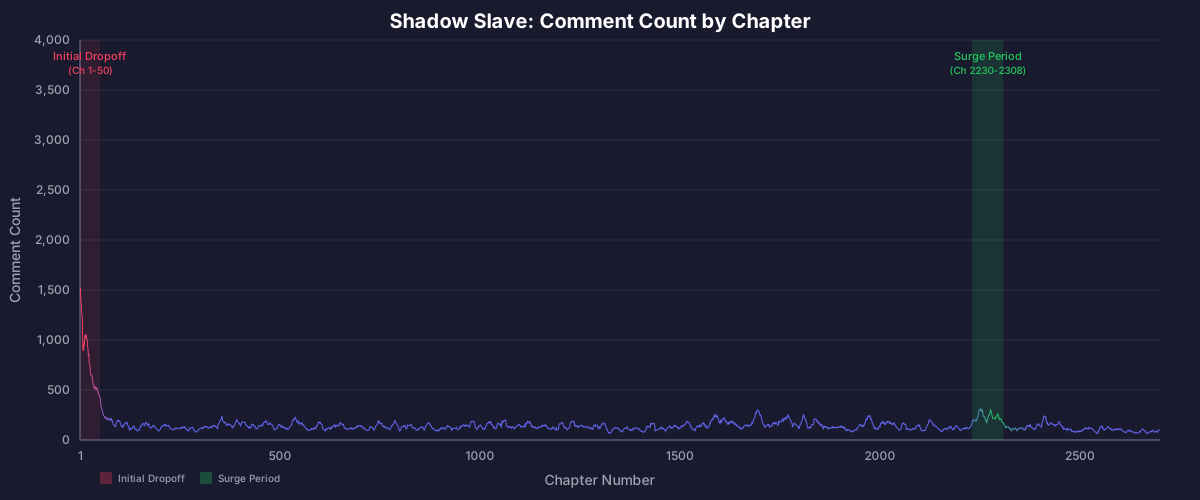
The numbers tell a story: readers don't just stay. They get more excited as the story progresses.
Let's dig into why.
Part 1: The First 50 Chapters (And Why They Matter)
Every serial fiction author obsesses over the opening chapters. Rightfully so. Reader drop-off in the first 50 chapters is brutal across the genre. But Shadow Slave does something interesting here.
The Author Gave Readers Something to Solve Together
When we analyzed comment language, something stood out: readers immediately started using collective language. "We," "everyone," "called it," "knew it." Not "I think" but "we all know."
This wasn't an accident. Guiltythree front-loaded the story with elements that demand collective discussion:
-
A protagonist with a brutal constraint: Sunny cannot lie. By chapter 17, readers were already collaborating on workarounds:
"solution: use half-truths and metaphors, like the elves from eragon." 1,966 likes
-
An underdog readers could root for together: Sunny starts as a "flawed" awakened—the lowest tier. Readers immediately adopted shared terminology:
"ooh so he's a shiny worthless" 2,012 likes
-
An MC who notices things: When Sunny recognized his former slaver in chapter 13, readers celebrated collectively because they'd been trained to pay attention too.
With 314 comments using collective language in our early chapter sample, it outpaced even character-specific discussions. The author didn't just write a story—he created puzzles and moments that readers could only fully enjoy by discussing together.
Readers also empathized with the constraint personally:
"The pain is unbearable. Would not last a day if I had to tell the truth." 1,842 likes
And when Sunny demonstrated intelligence in chapter 13—recognizing his former slaver when a typical MC would have missed it—readers celebrated:
"Smart mc ???????? Got me hopping around if it was another mc he would have overlooked the fact that this was his slaver" 1,423 likes
The 1,947-like top comment on that chapter was simply: "Hoooooly. This MC"
Takeaway for Authors: Your protagonist's constraints and intelligence matter more than their power level in the opening chapters. Give readers something to actively engage with, not just consume.
Part 2: The 2,000-Chapter Surge
Here's where the data gets interesting.
Conventional wisdom says engagement declines over time. Readers catch up, move on, find new stories. But in Shadow Slave's chapters 2,230-2,308, we found something different.
More Readers, More Excitement
During a pivotal arc where Sunny reached a long-awaited milestone, both comment volume and enthusiasm spiked:
| Metric | Before Surge (Ch 2100-2229) | Surge Period (Ch 2230-2308) | After Surge (Ch 2309-2400) |
|---|---|---|---|
| Avg Comments/Chapter | 122 | 234 | 123 |
| Positive Sentiment | 12.7% | 19.5% | — |
| Negative Sentiment | 1.4% | 1.3% | — |
This isn't gradual growth—it's a 92% increase in comment volume that returns to baseline once the arc concludes. Individual chapters peaked even higher: one hit 523 comments, another reached 463.
But volume alone doesn't tell the story. The quality of engagement shifted too. Positive sentiment jumped from 12.7% to 19.5% while negativity held steady. Readers weren't just showing up—they were showing up excited.
The Payoff Comments
The most revealing comments in the surge period celebrated long-awaited payoffs:
"Oh god. It's too much. It's too peak" 298 likes
"Peace, Solace, Death. The Lord of Shadows" 241 likes
These aren't comments from bored readers checking in. These are readers who've waited years for moments that finally arrived.
The Cliffhanger Culture
Something fascinating emerged in the late-game comments: readers had developed a shared language around suffering.
"Guilty attained supremacy and can now do cliffhanger mid chapter." 382 likes
"nah this hands down most OUTRAGEOUS CLIFFHANGER" 357 likes
"i wonder why did i saw that coming? Guilty should give online training courses for cliffhangers... until tomorrow my fellow sufferers" 268 likes
The author (Guiltythree, referred to as "Guilty" by the community) had become a character in the reading experience. The cliffhangers weren't frustrating; they were a shared ordeal that bonded the community together.
Takeaway for Authors: Trust your readers. Plant seeds early, deliver payoffs late. The readers who make it to chapter 2,000 aren't there by accident. They're invested. Reward that investment.
Part 3: What Makes a Chapter Explode
Our high-engagement outlier analysis identified 24 chapters that dramatically outperformed their neighbors. The patterns were consistent.
Long-Awaited Moments Win
The highest-engagement chapters weren't random plot twists. They were earned moments readers had waited hundreds (or thousands) of chapters to see.
"Finally...waited 1840 chapters for this" 430 likes
"yes!!!!!!!!!!! he said it!!!!! just another 1500ish chaps until he says it out loud" 550 likes
"Only took 1840 chapters and 8 volumes" 260 likes
Readers don't just notice foreshadowing payoffs. They celebrate them with the specific chapter count. They've been keeping track.
Character Moments Beat Action
When we analyzed theme distribution across high-engagement chapters, character themes dominated:
| Theme | Mentions in High-Engagement Chapters |
|---|---|
| Character Sunny | 479 |
| Community | 473 |
| Power System | 268 |
| Humor | 258 |
| Author Praise | 257 |
The power system discussions (a staple of progression fantasy) ranked third. Character and community came first.
Chapter 1812 ("Don't Let Me Be Misunderstood") generated massive engagement not from combat or leveling up, but from relationship dynamics:
"I need her POV next chapter, with Cassie also in her head" 418 likes
"And it's not because she's angry..." 296 likes
"Called it -- the reveal is a comedic" 193 likes
Readers were shipping. Theorizing about relationships. Celebrating character moments. The comments read more like a romance novel discussion than a progression fantasy thread.
Humor Sustains Everything
Across all three analysis periods, humor remained a top theme. Not just in the content itself, but in how readers engaged with each other.
"so our mc's a tsundre.." 827 likes
"Grylls: Finally an worthy disciple." 1,812 likes
"mongrel meet your buddy scoundrel. i believe you guys will be best friends XD" 302 likes
The funniest comments consistently outperformed serious analysis. Readers come for the story; they stay for the community. And community thrives on shared laughter.
Takeaway for Authors: Your readers are waiting longer than you think. A payoff at chapter 1,840 can generate more engagement than a twist at chapter 18. Readers remember. Reward their memory.
The Emotional Infrastructure
One comment from Chapter 45 stopped me cold during analysis:
"that hit me hard.
at the beginning of covid, my relationship with my parents was at an all time low and deteriorating... But this whole incident had a good thing come out of it. It forced my family to go to therapy... This hit me so much because for the past year and a half, I've had the luxury of a parent's love, yet understand what it is like to go without.
good job author" 978 likes
This comment has nothing to do with progression systems or power levels. A reader connected a chapter about Sunny's isolation to their own family struggles during COVID. Nearly 1,000 other readers saw themselves in that comment enough to like it.
Serial fiction, consumed over months and years, weaves itself into readers' lives in ways traditional publishing can't replicate. The story grows with the reader. It becomes part of their personal timeline.
That's not a marketing tactic. That's the product.
What This Means for Serial Fiction
1. Shared Experience Is Retention
Shadow Slave's comments aren't reviews. They're conversations. Jokes shared, theories debated, suffering commiserated. Readers don't stick around for 2,400 chapters because each one is perfect. They stay because leaving would mean leaving the collective experience.
For authors: Enable and encourage reader interaction. Respond to comments. Let inside jokes develop. The shared experience you cultivate is your retention strategy.
2. Constraints Create Engagement
Sunny's inability to lie could have been a minor quirk. Instead, it became a central tension that readers actively puzzle over. They suggest solutions, debate loopholes, celebrate workarounds.
For authors: Give your readers problems to solve alongside your protagonist. Constraints that persist across hundreds of chapters become community touchstones.
3. The Long Game Pays Compound Interest
A payoff at chapter 1,840 generates more emotional intensity than a twist at chapter 18 because readers have invested more. Time creates stakes no amount of clever plotting can manufacture.
For authors: Don't rush your reveals. Trust that readers who make it to chapter 500 are in for the long haul. Reward that investment with payoffs only serial fiction can deliver.
4. Humor Is Non-Negotiable
Even in a dark story about slavery, nightmare realms, and existential horror, the most-liked comments are jokes. Humor isn't a distraction from the serious content. It's the connective tissue that makes the serious content bearable.
For authors: If your comment sections feel flat, you might not be giving readers enough to laugh about together. Comic relief isn't optional in serial fiction.
5. Readers Notice Everything
They count the chapters until a moment happens. They remember promises made in chapter 15 and celebrate when they're fulfilled in chapter 1,500. They catch callbacks, track foreshadowing, and call out consistency errors.
For authors: Your most dedicated readers are paying closer attention than you might expect. Reward that attention with careful continuity and intentional callbacks.
Why We Analyzed This
At Chapter Chronicles, we're building tools for serial fiction authors and readers. Understanding why some communities thrive for years while others fade helps us build features that matter.
Shadow Slave isn't successful because Guiltythree cracked some secret formula. It's successful because the author committed to a long-term relationship with readers, delivered on promises made early, and created space for a community to form around the story.
That's not something you can shortcut. But it is something you can learn from.
Interested in more data-driven insights? Read our analysis of what 1,000 Primal Hunter reviews reveal about reader expectations.
This analysis was performed using natural language processing techniques including sentiment analysis, theme extraction, and engagement metrics on 9,752 Webnovel comments across Shadow Slave's 2,400+ chapters.
The Chapter Chronicles Team
Have questions about serial fiction engagement or reader community building? We'd love to hear from you at support@chapterchronicles.com.
If you're an author looking to build your own reader community, you can learn more about publishing on Chapter Chronicles or sign up free to get started.
Frequently Asked Questions
Why does Shadow Slave have such high reader retention?
How many chapters does Shadow Slave have?
Who is the author of Shadow Slave?
What makes web serial readers stay engaged for thousands of chapters?
How can authors improve reader retention in serial fiction?
Related Articles
Does Publishing Daily Actually Get More Followers? Data from 500+ Royal Road Serials.
Everyone says publish daily or get left behind. We collected data on 550+ Royal Road stories across every status and analyzed their publishing schedules. The surprising finding: frequency barely correlates with success — and when you control for story age, the effect disappears entirely.
The Content Rating Problem Nobody in LitRPG Is Talking About
We analyzed content rating systems across Royal Road, Wattpad, ScribbleHub, Amazon KDP, and AO3 — then combined that with demographic data, payment processor policies, and firsthand observations from LitRPGCon 2025. The findings reveal an audience gap most authors don't know exists and a payment processor chain that treats violence and sex very differently.
How Sky Pride Hit #1 on Royal Road Without Reinventing a Single Trope
Sky Pride is the highest-rated ongoing story on Royal Road. It uses every xianxia trope in the book—sects, pill refining, flying swords, ghost grandpa in a ring. We analyzed reviews, Reddit threads, and author strategy to understand why execution beats innovation.
Ready to Start Publishing Your Story?
Join authors building their creative business on Chapter Chronicles. Free to start, simple pricing when you earn.
Sign Up Free