
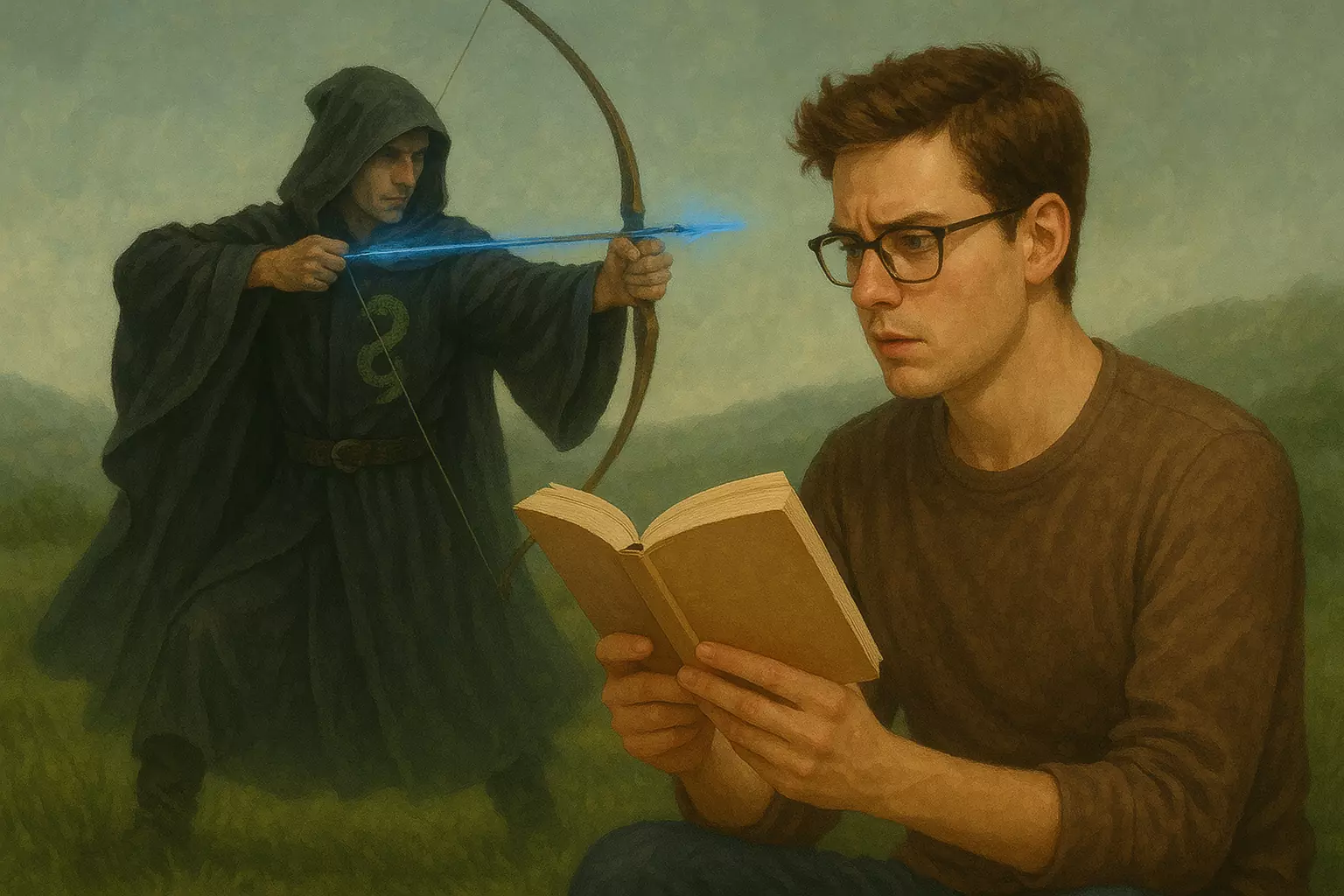
What 1,000 Primal Hunter Reviews Reveal About Reader Expectations
By Chapter Chronicles Team
•
December 6, 2025
•
9 min read
I'm a Primal Hunter fan.
Like many readers, I had a complicated relationship with the early chapters. We spent a long time in the tutorial, much longer than I expected when I first picked up the story. There were moments I almost dropped it. But something kept me reading: the world Zogarth was slowly pulling together, the glimpses of a larger multiverse, the promise of something bigger.
I stuck with it. And I'm glad I did.
Now, with the story well past chapter 1,000 on Royal Road and a successful audiobook series on Audible, The Primal Hunter has become one of the defining works of the LitRPG genre. So when we started thinking about what readers actually want from serial fiction, we knew we had to analyze this story.
We analyzed 1,053 reviews spanning October 2020 to November 2025. What we found challenged some of our assumptions about what makes serial fiction successful.
The Data at a Glance
| Metric | Value |
|---|---|
| Total Reviews Analyzed | 1,053 |
| Total Words (cleaned) | 58,084 |
| Average Review Length | ~55 words |
| Most Discussed Topic | Characters (896 mentions) |
| Most Positive Aspect | Humor (93.7% positive) |
| Lowest Sentiment Aspect | Combat/Action (63.2% positive) |
Let's dig into what this actually means.
The Humor Surprise: 93.7% Positive
This was the biggest finding, and frankly, not what we expected.
When you think about what makes a LitRPG successful, you probably think: cool system, satisfying progression, epic fights. And yes, readers care about those things.
In hindsight, maybe we shouldn't have been so surprised. Look at the meteoric rise of Dungeon Crawler Carl, a series where dark comedy is the entire point. Matt Dinniman built an empire on making readers laugh while the world burns. But DCC leads with humor; it's the premise. We didn't expect to see comedy dominate sentiment in a power-scaling system apocalypse story where the MC spends hundreds of chapters grinding levels and fighting eldritch horrors.
Maybe something is shifting in fantasy. Readers are tired of grimdark without relief, of protagonists who brood through every chapter. They want to feel something other than tension, and humor delivers that.
But humor dominated positive sentiment with a staggering 93.7% approval rate, far above any other aspect we measured.
Readers consistently praised the Jake and Villy dynamic, calling their banter "hilarious" and "one of the funniest parts of the story." The comedic relief wasn't just tolerated; it was loved.
"The banter between Jake and Villy is hilarious"
"One of the funniest LitRPGs I've ever read"
For authors writing in dark or intense genres like system apocalypse, this is a critical insight: comic relief isn't optional, it's essential. Readers need moments of levity to balance the tension, and they'll reward you for it.
Characters Beat Systems (And It's Not Close)
"Characters" appeared 1,539 times across reviews (combining singular and plural forms). That's more than any other topic, including "system" (426), "progression" (157), or "combat" (57).
The top bigram (two-word phrase) across all reviews? "Main character" with 187 mentions.
Here's how aspects ranked by sentiment:
| Aspect | Mentions | Positive % |
|---|---|---|
| Humor | 253 | 93.7% |
| World Building | 477 | 82.8% |
| Plot/Story | 820 | 83.4% |
| Characters | 896 | 80.6% |
| Progression System | 631 | 81.1% |
| Writing Quality | 625 | 80.5% |
| Pacing | 288 | 64.9% |
| Combat/Action | 399 | 63.2% |
Despite LitRPG being a genre defined by game-like systems and progression mechanics, readers spent far more time discussing Jake as a person than Jake's skill tree.
They talked about his relationship with Villy. They analyzed his personality flaws. They debated whether he was too antisocial or just the right amount of independent.
"Jake is a dick, yeah, but a nice, fun one."
"I love how everyone bullies Jake by forcing him into social interactions"
The lesson for authors: Your system is the hook, but your characters are the retention. Readers might pick up a story for an interesting class system, but they stay because they care about the people in it.
The Pacing Problem
Remember how I almost dropped the story during the tutorial?
I wasn't alone.
Pacing had one of the lowest positive sentiment scores at 64.9%, with 35% of mentions being negative or neutral. The word "tutorial" appeared 171 times, often alongside complaints about length.
Common criticisms included:
- "The tutorial dragged on way too long"
- "Some arcs feel like filler"
- "Sometimes so fast you are almost getting whiplash"
Interestingly, the complaints weren't just about being too slow. Some readers felt certain sections moved too fast, not giving events time to breathe.
The challenge with serial fiction is that readers consume it over months or years. An arc that reads fine when binge-read can feel interminable when you're reading it chapter-by-chapter over six weeks.
For authors: Consider your release schedule when planning arc length. A 50-chapter tutorial might work in a completed novel but feels endless when it takes 10+ weeks to get through.
Combat: The 63% Problem
Here's a counterintuitive finding: combat/action had the lowest positive sentiment of any major aspect at 63.2%.
In a genre where the main character fights monsters every chapter, over a third of combat-related comments were negative or neutral.
The complaints fell into predictable patterns:
"Fights can get repetitive"
"Stakes feel low when MC is so overpowered"
"It's just killing monsters, killing people, kill kill kill."
This is the overpowered protagonist paradox. Readers want to see Jake become powerful (that's the whole point of progression fantasy), but once he's strong enough to one-shot most enemies, the fights lose tension.
Zogarth handles this better than many by constantly introducing higher-tier threats, but even then, readers noted the pattern: Jake faces impossible odds, Jake wins anyway, repeat.
For authors writing power fantasies: The challenge isn't making your MC strong, it's keeping fights interesting after they're strong. Consider non-combat challenges, political conflicts, or emotional stakes that raw power can't solve.
What Readers Love (In Order)
Based on our topic modeling, here are the themes that generated the most positive engagement:
1. General Praise & Recommendations (126 reviews)
Reviews dominated by words like "love," "favorite," and "recommend." These readers were enthusiastic evangelists for the story.
2. Progression System Discussion (115 reviews)
Despite combat issues, readers enjoyed discussing the system, analyzing classes, skills, and advancement paths.
3. Character Analysis (107 reviews)
Deep dives into Jake, Villy, and side characters. Readers analyzed motivations, relationships, and growth arcs.
4. World Building (106 reviews)
The multiverse, the gods, the factions. Readers appreciated the scale and depth of the setting.
5. Writing Quality (102 reviews)
Grammar, style, and prose quality. Notably, readers appreciated that Zogarth maintained consistent quality across 1,000+ chapters.
The Mixed Review Problem
We found 168 reviews with notably mixed sentiment: readers who loved certain aspects while harshly criticizing others.
One reviewer rated characters at 0.93 (highly positive) while rating world building at -0.67 (negative). Another loved the world building (+0.79) but hated the combat (-0.89).
This suggests that Primal Hunter succeeds because it excels in enough areas that readers forgive its weaknesses. No story is perfect, but if you nail the things readers care most about (characters, humor, world), they'll overlook pacing issues or repetitive fights.
What This Means for Serial Fiction
If you're an author writing serial fiction, here's what we learned from analyzing 1,053 Primal Hunter reviews:
Double Down on Characters
Your protagonist's personality, relationships, and growth matter more than their skill build. Give readers someone to root for, and they'll follow them through slow arcs.
Humor Is Your Secret Weapon
Even in dark genres, comedic relief isn't just nice to have; it's one of the highest-rated aspects of successful serial fiction. Find natural places for levity.
Respect Your Pacing
Serial readers experience your story differently than binge-readers. An arc that works in a novel might drag as weekly releases. Consider chapter hooks and arc length carefully.
Combat Isn't Everything
Readers want to see your MC progress, but they don't need every chapter to be a fight. Variety keeps engagement high.
World Building Pays Off
Readers remember and appreciate lore. The investment in multiverse depth, faction politics, and divine hierarchies gave Primal Hunter staying power.
Why We Did This Analysis
At Chapter Chronicles, we're building tools for serial fiction authors and readers. Understanding what readers actually care about, not what we assume they care about, helps us build better features.
This analysis is part of a series. We've also analyzed what 2,400 chapters of Shadow Slave taught us about reader retention, and we plan to continue exploring successful serials to see if these patterns hold across different genres and writing styles.
If you're an author interested in understanding your own reader feedback at this level, we're working on analytics tools that will help you see what's resonating and what's falling flat.
And if you're a Primal Hunter fan like me, hopefully this gave you a new appreciation for why the story works, even when the tutorial feels endless or the fights get predictable.
The data doesn't lie: we're here for Jake and Villy, and we're not going anywhere.
This analysis was performed using natural language processing techniques including sentiment analysis, topic modeling (NMF), and word frequency analysis on 1,053 Royal Road reviews spanning October 2020 to November 2025.
The Chapter Chronicles Team
We're readers and writers who believe serial fiction deserves a platform built for the reading experience. If you have thoughts on this, we'd love to hear from you at support@chapterchronicles.com.
If you're an author looking to move beyond PDFs and EPUBs, you can learn more about publishing on Chapter Chronicles or sign up free to get started.
Related Articles
Ready to Start Publishing Your Story?
Join authors building their creative business on Chapter Chronicles. Free to start, simple pricing when you earn.
Sign Up Free